단기4359년
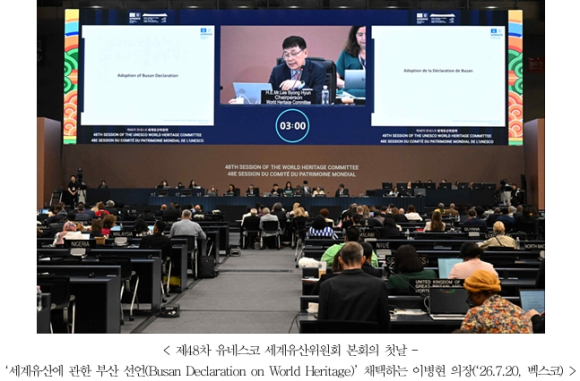
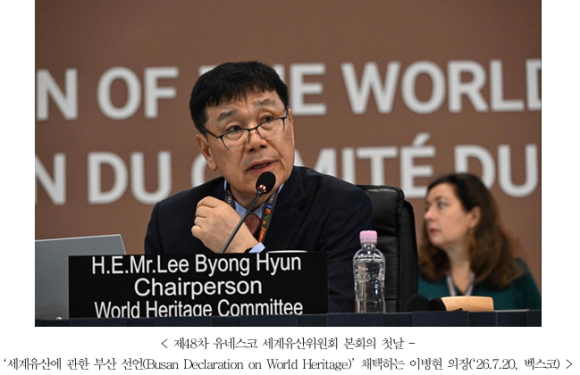
국가유산청(청장 허민)과 외교부(장관 조현)는 7월 19일 부산에서 개회한 ‘제48차 유네스코 세계유산위원회(이하 ‘위원회’)’의 본회의 첫날인 7월 20일 오전 ‘세계유산에 관한 부산 선언(Busan Declaration on World Heritage, 이하 ‘부산 선언’)’을 컨센서스로 채택하였다.
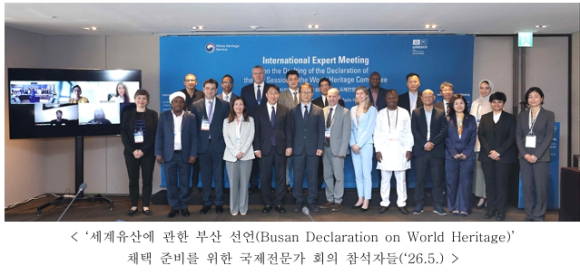
이번 부산 선언은 의장국인 대한민국이 주도하고, 21개 세계유산위원국* 및 세계유산위원회 3대 자문기구(ICCROM, ICOMOS, IUCN)** 전문가들이 참여하여 초안을 작성하였다. 올해 4월 우리 정부는 유네스코 한국위원회(사무총장 홍현익)와 협력하여 국내 전문가 공청회 및 국제전문가 화상회의를 실시하고, 5월에는 국제전문가 회의를 서울에서 개최하여 폭넓은 의견을 수렴하였다. 그 이후 위원국 간 최종 조율 과정을 거쳐 선언 채택 준비 작업을 마무리하였다.
* 세계유산위원회 21개 위원국(가나다순): 그레나다, 대한민국, 레바논, 몽골, 방글라데시, 베트남, 세네갈, 스위스, 아르메니아, 아제르바이잔, 우크라이나, 자메이카, 체코, 탄자니아, 토고, 튀르키예, 폴란드, 페루, 카자흐스탄, 쿠웨이트, 케냐
** ICCROM: 국제문화유산보존복구연구센터 / ICOMOS: 국제기념물유적협의회 / IUCN: 세계자연보전연맹
|
 |
|
| ⓒ hy인산인터넷신문 |
|
선언문에는 무력분쟁, 기후변화, 개발상의 압력 등 세계유산을 둘러싼 복합 도전에 함께 대응하기 위한 협력의 중요성을 담았다. 특히 세계유산협약의 기존 다섯 가지 전략목표(5Cs)*에 새로운 전략목표(Strategic Objectives)로 ‘협력(Collaboration)’을 추가할 것을 제안하고, 세계유산 분야 최초로 디지털 전환과 그에 따른 책임에 대한 논의를 공론화했다는 점이 특징이다. 또한, 세계유산의 체계적 보존관리를 위해 각 유산의 가치를 전문적 식견에 기반해 책임 있게 해석하고 설명하는 ‘포용적 해석’과 세계유산 관리의 ‘공동 책임’의 중요성, 그리고 각국 세계유산 현장관리자들의 지속적인 역량 강화, 문화유산과 자연유산 간 긴밀한 상호의존성과 통합적 접근의 필요성 등에 대한 의제도 포함하고 있다.
* 세계유산협약의 효과적인 이행과 세계유산의 지속가능한 보호를 위해 설정한 다섯 가지 기준으로, 신뢰성(Credibility), 보존(Conservation), 역량 강화(Capacity-building), 소통(Communication), 공동체(Communities)로 구성됨(Five Cs).
|
 |
|
| ⓒ hy인산인터넷신문 |
|
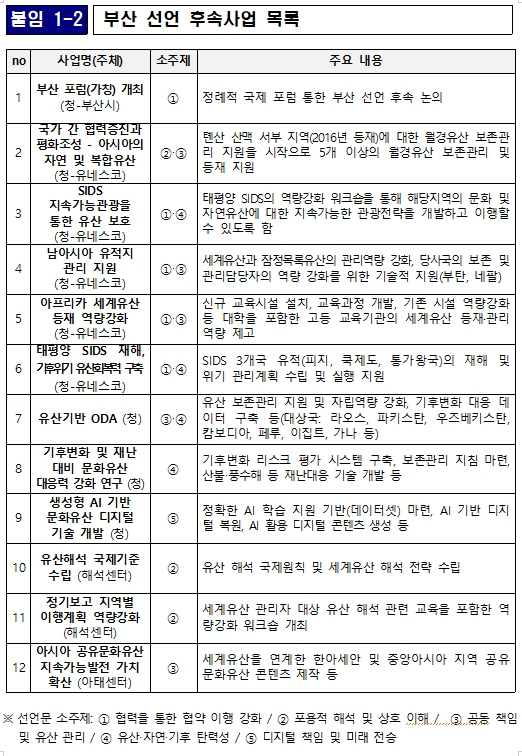
한편, 국가유산청은 이번 선언문 발표를 계기로 더 구체적이고 실질적인 성과를 창출할 수 있도록 후속 사업을 추진할 계획이다. 이와 관련하여, 20일 오후 1시에 진행되는 위원회 공식 기자회견에서 허민 국가유산청장은 국가유산청, 부산시, 유네스코, 국내 카테고리2센터 등이 협력하여 추진할 총 12건의 후속 사업 추진 계획을 설명할 예정이다.
국가유산청은 후속사업 또한 성공적으로 추진하여 세계유산 분야에서의 국제적 리더십을 공고히 하고, 당사국뿐 아니라 세계유산 관련 다양한 전문가, 현장관리자, 공동체 간의 협력을 선도할 예정이다.
* 카테고리2센터: 유네스코와 회원국 정부가 협정을 맺어 설립한 국제협력 기관으로, 우리나라에는 WHIPIC(세계유산국제해석설명센터), ICHCAP(아태무형유산센터) 등 총 7개 센터가 있음.
국가유산청과 외교부는 이번 세계유산위원회에서 발표한 부산 선언이 세계유산협약의 발전과 지속 가능성을 위한 이정표가 될 수 있도록 지속적으로 노력할 예정이다.
|
 |
|
| ⓒ hy인산인터넷신문 |
|
|
 |
|
| ⓒ hy인산인터넷신문 |
|
Busan Declaration on World Heritage
(48th session of the World Heritage Committee, Busan, 20 July 2026)
We, the members of the World Heritage Committee, meeting in Busan, Republic of Korea, on the occasion of its 48th session,
Recalling the Convention concerning the Protection of the World Cultural and Natural Heritage of 1972(hereinafter referred to as the “Convention”), and reaffirming that the identification, protection, conservation, presentation and transmission to future generations of cultural and natural heritage of Outstanding Universal Value (hereinafter referred to as “OUV”) remain the primary objectives of the Convention,
Recalling further the relevant declarations adopted within the framework of the Convention, which emphasize the strategic objectives for its implementation and the need for strengthened collaboration within the World Heritage system, including the Budapest Declaration (2002), the Bonn Declaration (2015), the Istanbul Declaration (2016), the Baku Declaration (2019), and the Fuzhou Declaration (2021),
Noting also the outcomes of the UNESCO conferences MONDIACULT 2022 and 2025, as well as relevant United Nations frameworks and international commitments, which highlight the interlinkages between culture, heritage and nature and their relevance to sustainable development, peace and crisis response,
Recognizing that World Heritage properties and their associated communities are increasingly, albeit unevenly, affected by multiple and interconnected global challenges, including armed conflict, disasters and other emergency situations, climate change, biodiversity loss, and environmental, social and developmental pressures, as well as rapid technological change, with implications, where relevant, for their buffer zones and wider settings,
Affirming that cultural and natural heritage, together with associated knowledge systems and practices, should be recognized not only as subjects of protection, but also as vital resources for resilience, recovery and human dignity, and for dialogue, mutual understanding, solidarity and sustainable peace, consistent with the purposes of the Convention,
Expressing appreciation to the Government of the Republic of Korea for its contribution to the organization and preparation of this session,
Declare the following:
Collaboration should be recognized as the sixth C of the World Heritage system, alongside Conservation, Credibility, Capacity-building, Communication and Communities. This recognition emanates from the understanding that the present context of multiple and growing interconnected global challenges presents complex and cross-cutting issues that the existing five strategic objectives, when pursued in isolation, are not sufficient to address. Collaboration should therefore be recognized as the sixth C in terms of strategic visibility, while operating as a cross-cutting principle in terms of function: it is intended not to replace or diminish the existing 5Cs, but to connect and reinforce them.
1. Strengthening the Implementation of the Convention through Collaboration
We reaffirm the responsibility of the World Heritage Committee to promote the effective implementation of the Convention with credibility, consistency and transparency, through evidence-based decision-making, due regard to the technical advice of the Advisory Bodies, and the effective use of existing mechanisms.
As the sixth C, Collaboration should strengthen this implementation through shared responsibility, mutual support, knowledge-sharing and capacity-building, taking into account the diverse needs and capacities of States Parties. It should promote collaborative action across borders, levels of governance, institutions, disciplines and knowledge systems, including, where appropriate, transboundary initiatives. It should also support coordinated risk preparedness, response and recovery for World Heritage properties affected by armed conflict, disasters and other emergency situations, particularly where these exceed the capacities of individual States Parties.
2. Inclusive Interpretation, Transmission and Mutual Understanding
We recognize that interpretation, presentation and transmission, as integral parts of the overall process of conservation and management, shape how World Heritage is valued, understood, and communicated, and therefore carry a public responsibility. Such processes should be responsible, evidence-based and informed by expertise and should include multiple interpretations by local communities. It should remain consistent with the spirit of the Convention, the Operational Guidelines and the protection of OUV, including the conditions of integrity and authenticity.
We encourage collaborative, participatory and inclusive approaches to interpretation and communication that, where appropriate, are informed by multiple perspectives and engage relevant stakeholders, including Indigenous Peoples, local communities and knowledge holders, through consultation, dialogue and knowledge-sharing. By integrating diverse values, meanings and cultural memories through participatory processes, such approaches can strengthen the understanding of the OUV of World Heritage properties, while contributing to mutual understanding, social cohesion and the transmission of World Heritage values.
3. Shared Responsibility, Stewardship and Capacity-building
We encourage approaches to the conservation and management of World Heritage that, while respecting the responsibilities of States Parties under the Convention, strengthen shared responsibility, practical solidarity and long-term public interest, and that adopt participatory, inclusive and rights-based approaches to stewardship, recognizing, as appropriate and where applicable, the role of local communities, youth, Indigenous Peoples, cultural bearers and knowledge holders as active partners in sustaining and transmitting the meaning, living relevance and values of World Heritage.
We recognize the important role of site managers and management authorities, and encourage capacity-building, peer-learning and the development of practical approaches and tools to support responsible stewardship, sustainable tourism and visitor management, and to address pressures affecting the conservation, integrity and authenticity of World Heritage properties, thereby strengthening connections between people and places and supporting effective heritage governance.
4. Heritage, Nature, Climate Resilience and Sustainable Development
We recognize the close interdependence of cultural and natural heritage, including the relationships between communities, biodiversity and cultural practices, as well as associated livelihoods and spiritual connections, within the framework of the Convention.
We note with concern that climate change, biodiversity loss, disaster risks and related environmental pressures pose significant threats to World Heritage properties and their associated communities. We therefore encourage collaborative, integrated and forward-looking approaches that strengthen protection, monitoring, risk-informed planning, adaptation and resilience, drawing where appropriate on time-tested traditional practices; that align World Heritage protection with broader environmental, climate and sustainable development strategies; and that foster, where appropriate, greater synergies with other relevant UNESCO conventions, programmes and international frameworks.
5. Digital Responsibility and Transmission to Future Generations
We recognize that digital technologies, including artificial intelligence, are increasingly shaping the ways in which World Heritage is identified, documented, interpreted, accessed, preserved and transmitted.
We encourage transparent, responsible and accountable digital practices that support prevention, emergency response, recovery, long-term conservation and knowledge-sharing across generations, with due attention to accuracy, context, inclusivity, equitable access and respect for international law, including international human rights law. Such practices should uphold ethical standards, respect the rights and interests of communities concerned, including in relation to traditional and Indigenous knowledge, and ensure equal access by addressing disparities in digital access, connectivity and technical capacities, as well as risks to the integrity, security and long-term preservation of heritage-related data.
We encourage States Parties, UNESCO, the Advisory Bodies, site managers, communities and relevant stakeholders to advance these aims through effective collaboration within the World Heritage system.
|

 회원가입
회원가입 기사쓰기
기사쓰기

 입력 : 2026년 07월 20일






 10대 함양군의회 첫 임시회 개회..


